
Sidney Neighbors Block Sources
Different records answer different block questions. The parcel viewer shows the map relationship around an address. The Auditor supplies the property record. The Recorder documents recorded instruments. Board of Elections reports have a defined voter-data role, and City Civic Access is about address-based public activity. None is a complete list of every person who lives nearby.
| Source | What It Shows About a Block | Access |
|---|---|---|
| 2D Parcel Viewer | Adjacent parcels, owner/contact field groups, legal description, sale/value/tax data, and map layers | Address, owner, or parcel query, then adjacent polygons or Near Me. |
| Auditor property search | Parcel and property record | Free county property portal. |
| Shelby County Recorder | Recorded instruments tied to a parcel or legal description | Account index for 1989 forward, then Recorder counter, books, or copy channel for earlier material. |
| BOE street and precinct reports | Public voter-list data within statutory limits | Street Report Generation or the Board office, with protected voter records withheld. |
| Sidney Civic Access | Permits, plans, inspections, code cases, and licenses | Public search tile; post-login filters were not verified. |
| Directory, map, and newspaper collections | Historic address and neighborhood context | Library, SCGS, or SCHS repositories, not current-neighbor proof. |
A parcel's listed owner or contact address does not establish every resident at that parcel. A Recorder entry shows a recorded transaction, not a household roster. Historical collections are useful for an older block question, but they do not prove who lives there now. Treat a field as the custodian labels it, with its record date, instead of merging these separate sources into a single identity claim.
Map Sidney Neighbors in 2D
The Shelby County 2D Parcel Viewer has a concrete immediate-block method. It begins with a location address, listed owner name, or parcel number, then works outward from the focal polygon. This is a radius or adjoining-parcel review, not the full record chain for a named street.
Block flow: address or owner query → focal parcel → adjacent polygons or Near Me → filtered, distance-sorted parcel results → recorded ownership documents when needed.
- Query by address, listed owner, or parcel number, then select the focal result and zoom to its polygon.
- Choose the adjacent polygons or select Near Me for a radius search.
- Draw a point, line, or polygon around the area to be checked.
- Start with the viewer's 500-foot default distance, then adjust the distance and unit to match the actual block question.
- Read the results in distance order and filter by owner, city/state/ZIP, sale, value, class, or district.
- Export CSV only after the filter is set, then preserve field labels rather than turning the export into an occupancy list.
When the question expands from an immediate radius to a full named street, use the Sidney street directory for the address-by-address trail. The near-parcel method stays focused on the block that surrounds the starting location.
Filter Sidney Neighbor Results
The map can reveal a useful set of parcel facts: parcel number, listed owner, legal description, deed volume and page, sale details, values, tax fields, location city/state/ZIP, owner contact fields, taxpayer contact fields, and geometry. The location and contact groups are separate. A contact mailing field can be checked against a location field, but it does not prove that a person occupies or does not occupy the parcel.
| Official record approach | Generic commercial neighbor-search category |
|---|---|
| Preserves the custodian, field label, parcel, and record type so a result can be checked. | May combine public and unverified data, charge for results, and omit the source context needed to test a claim. |
| Shows the limits of a property, voting, or recorded-document source. | Can be stale or wrong and cannot replace the county custodian's own record. |
Use the official record trail when a result matters. A close parcel does not establish a family relationship, a shared household, or an invitation to make contact. If the fields conflict, leave the conflict visible and ask the custodian about the record rather than resolving it by inference.
The comparison is especially important when the map's Near Me result is broad. Near Me identifies nearby parcels and sorts them by distance. A voter lookup, by contrast, confirms an individual registration only after required name inputs. Neither tool is designed to answer every relationship on a block, and their different limits should remain visible in any research notes.
Sidney Neighbors Records by Request
Police records are a narrow, incident-specific channel, not a neighbor directory. The Sidney Police Records page lists arrest reports, calls for service, incident reports, and motor-vehicle accident reports. Most reports are stated to become available 48 to 72 hours after creation. A request may be made by email, in person, or by mail to the Records Department; a mailed request needs the written request, a self-addressed stamped envelope, and payment.
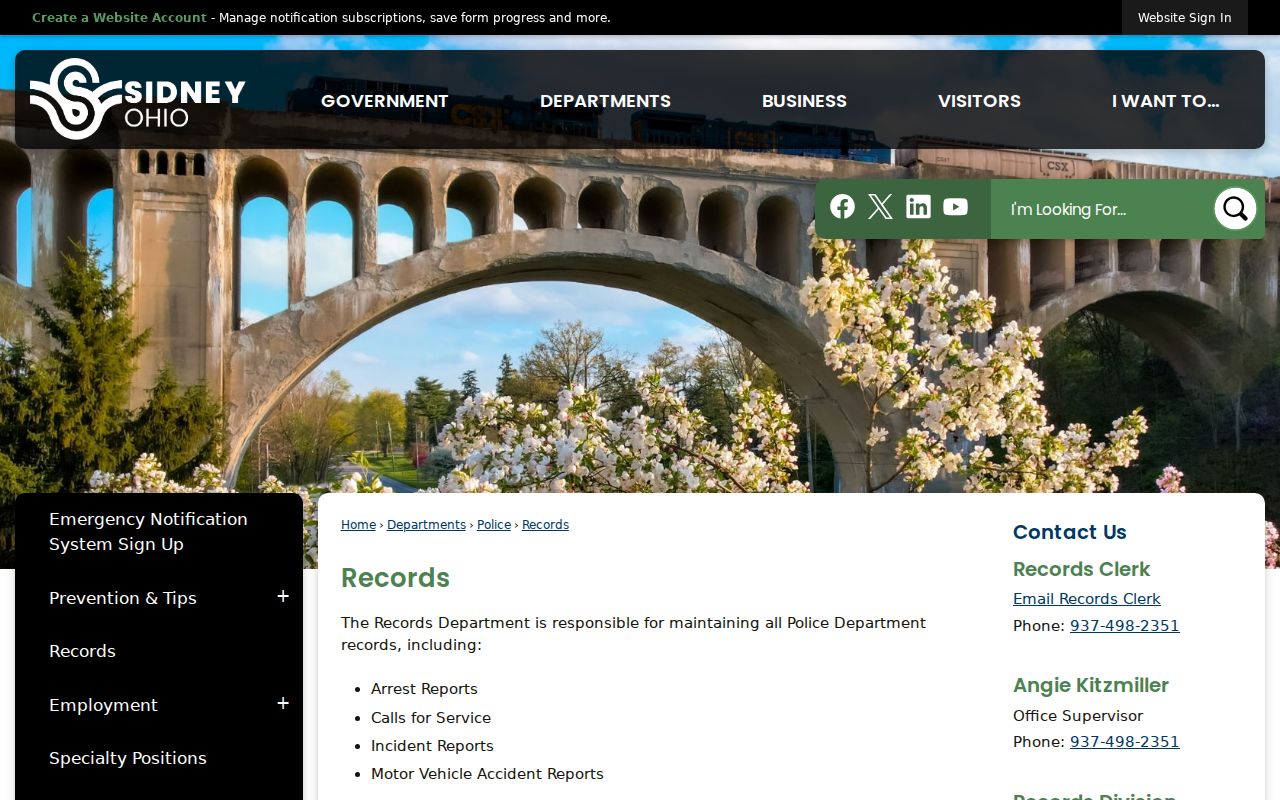
Use the request channel only to seek an identified report or event. A written request is not required under R.C. 149.43(B)(5), but it can help the Records Department locate a record. The City's form can narrow a request with a report number, date, time, location, and detailed description. It also notes that released material may be redacted. Paper report copies may cost 5 cents per page, but a report request is not a way to construct a list of people around an address.
Sidney Neighbors and BOE Reports
The ordinary Shelby voter lookup requires a last name and first name. Ohio's statewide tool requires first name, last name, and county, then can offer a dynamic Street Name selector to narrow a confirmed result. Those tools support an individual registration, precinct, or polling-place question. They cannot browse a street for neighbors.
For a block question, Shelby Board of Elections tools identify Street Report Generation and precinct lists as the proper Board channel. The Board also lists Voter Report Generation, Absentee Report Generation, polling-place tools, and other election utilities. Current report parameters should be verified with the Board rather than assumed from the individual lookup form.
Ohio R.C. 3503.13 excludes phone numbers, email, identification numbers, confidential records, certain protected addresses, citizenship proof, and other protected information from the public registration material. Safe at Home voters are confidential. R.C. 3503.26 also has an election-period disruption window for accessible precinct registration lists, so the Board is the correct source for access timing and available fields.
Note: A Board street report is the block-level route; a name-required voter lookup is not a street browser or a complete neighbor list.
Sidney Community Research Repositories
Targeted research did not locate a City neighborhood-association umbrella directory, an authoritative HOA member list, or a chamber roster suitable for resident lookup. That absence matters. Do not treat a community group name, a historic-site page, or an old address mention as a current membership list.
Shelby County Historical Society and the Shelby County Genealogical Society are repositories for local-history research, not live rosters. SCHS supplies resource links for newspapers, atlases, maps, and Sanborn material. SCGS supports microfilmed newspapers, courthouse records, family genealogies, and books at the Ross Historical Center. Those sources can give historical context for a block without asserting a present-day neighbor relationship.
SCHS Resource Library and Archives publishes an archives page as well as its resource links. Its stated hours are Monday through Friday from 1 to 5, with Saturday visits by appointment. SCGS was founded at Amos Memorial Library in 1975 and opened its Ross Historical Center research center in 2015. These details make the repositories useful fallback channels when a public portal starts too late or an older block needs a map, abstract, or newspaper check.
SCGS indexes some church material from Port Jefferson and nearby communities, but those records are collection-specific and not citywide resident rolls. A historic address may be a useful lead for a family-history question. It still needs a dated source and a separate current-record check if the question concerns the present.
Sidney Neighbors Privacy Limits
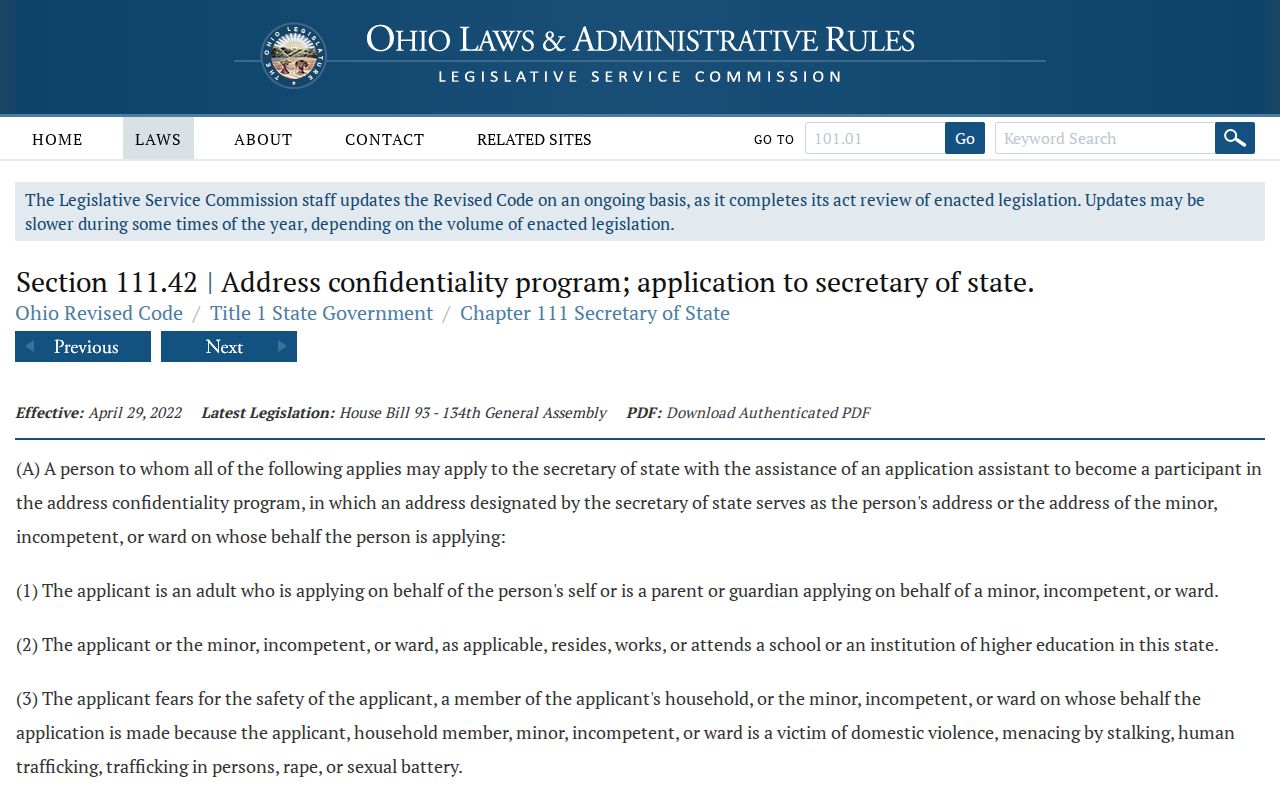
Ohio Safe at Home is a central limit on any block search. Under R.C. 111.42, an eligible adult applying for self, a minor, or a ward may seek address confidentiality when statutory safety conditions are met. The application uses an application assistant, a notarized fear statement, and an assistant recommendation. The Secretary of State must act within ten business days on a complete application, and certification lasts four years with a 60-day renewal grace period.
The Ohio Safe at Home eligibility statute is the primary source for those conditions and the application framework.
A participant who acquires property may submit a real-property confidentiality notice. After that, the Recorder, Auditor, Treasurer, and Engineer must not disclose identifying information with the legal description, parcel ID, or street address, subject to statutory exceptions. This is why a public parcel or deed trail can have a deliberate gap. Ask the custodian about an exemption or protected-participant rule, and do not attempt to reconstruct withheld information.
Sidney Neighbor Fraud Reports
Public records do not guarantee identity or a current address. Watch for a deed-copy offer that does not match the Recorder, a request for payment before an official unclaimed-funds check, a caller claiming to be police or court staff, or a pressured family emergency story. Verify with the published office number or the original custodian, not caller ID or a link supplied by the caller.
The FTC ReportFraud portal is the federal channel named for deceptive consumer conduct and identity fraud reporting.
For a suspicious records denial, ask the custodian for the statutory authority in writing and use its public-records policy. For a local non-emergency concern, use the agency's published channel. Preserving the source, date, and field label is more useful than circulating an unverified block result.